
Knowledge · Guide
Choose document boundaries around the questions people ask
Compare chunking strategies against real retrieval needs instead of chasing a universal token size.

Start with the smallest complete rule
A chunk should preserve the context needed to interpret a rule. A paragraph containing a deadline but omitting its exceptions is an unsafe unit for some workflows. Take a set of approved questions and highlight the smallest passages that fully support their answers. This provides a reference for evaluating fixed-size, heading-based, or layout-aware chunking without assuming one method is always superior.
Measure broken context
For a hypothetical property-management guide, test questions that need a heading, a warning box, and a nearby table. Inspect retrieved chunks before looking at the generated answer. Count whether essential context was split away, duplicated, or attached to the wrong topic. If retrieval fails, a more eloquent generation prompt may simply hide the problem. Fix the evidence unit before tuning the assistant’s tone.
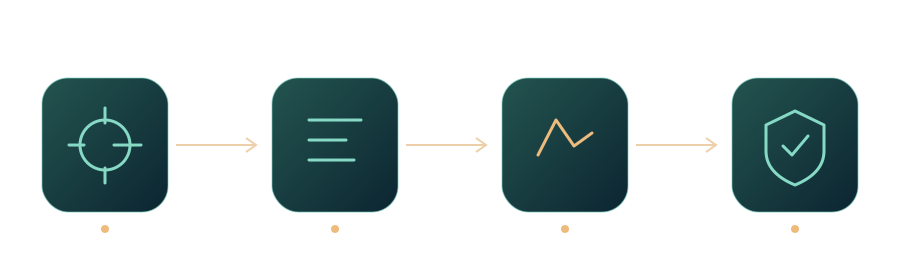
Workflow at a glance
Compare practical alternatives
Try a small number of clearly different configurations using the same documents and questions. Include processing cost, update effort, latency, and reviewer readability. Structure-aware methods require reliable parsing; a broken heading tree can create confidently mislabeled chunks. Do not add extensive overlap without checking duplicate retrieval. Select the simplest approach that reliably preserves the evidence needed for your pilot’s decisions.
Keep a change record
When boundaries change, re-run the retrieval tests and retain the old configuration until the new one is accepted. Existing stored citations may point to obsolete chunk identifiers. Plan a way to resolve them back to document passages. The official parsing sources explain technical options; the recommendation here is to make chunking a versioned editorial and engineering decision with an accountable owner.
A boundary comparison sheet
For each difficult question, place the original evidence and retrieved chunks side by side. Mark omitted conditions and duplicated passages. This simple worksheet often gives content owners a clearer improvement target than a discussion about token sizes and vector-distance settings.
Sources and further reading
- Parse and chunk documentsParse and chunk documentsGoogle Cloud · Documentation ·
- Retrieval-Augmented Generation with Azure Document IntelligenceRetrieval-Augmented Generation with Azure Document IntelligenceMicrosoft · Documentation ·
Editorial approach
AI-assisted original writing, checked against linked public sources. Practical recommendations and illustrative scenarios are editorial analysis, not reported client results. Source dates and product details may differ from this collection’s preparation date.