
Operations · Guide
Employee-Built AI Agents Need an Owner Before They Need a Platform
Employees no longer need a central engineering team to build every AI agent. A sales coordinator can assemble a quote-drafting assistant; an operations analyst can create a stock-alert agent; an office manager can automate inbox triage. That speed is valuable, but it creates a quiet management problem: after the builder changes roles, who knows what the agent can reach, what it is allowed to do, and when it should stop? Before buying a larger control platform, a small business needs a reliable answer to a simpler question: **Which agents exist, and who owns each one?**
Employee-Built AI Agents Need an Owner Before They Need a Platform
Original AAHouse explanatory video. AI-assisted conceptual visuals and neural narration; original music.
Q1 — Why count agents at all?
Interview rule: if the team cannot answer one question in one sentence and point to evidence, the agent is not ready for production.
Fast answer: Every active agent needs a purpose, a named owner, bounded authority, current status, evidence location and retirement trigger.
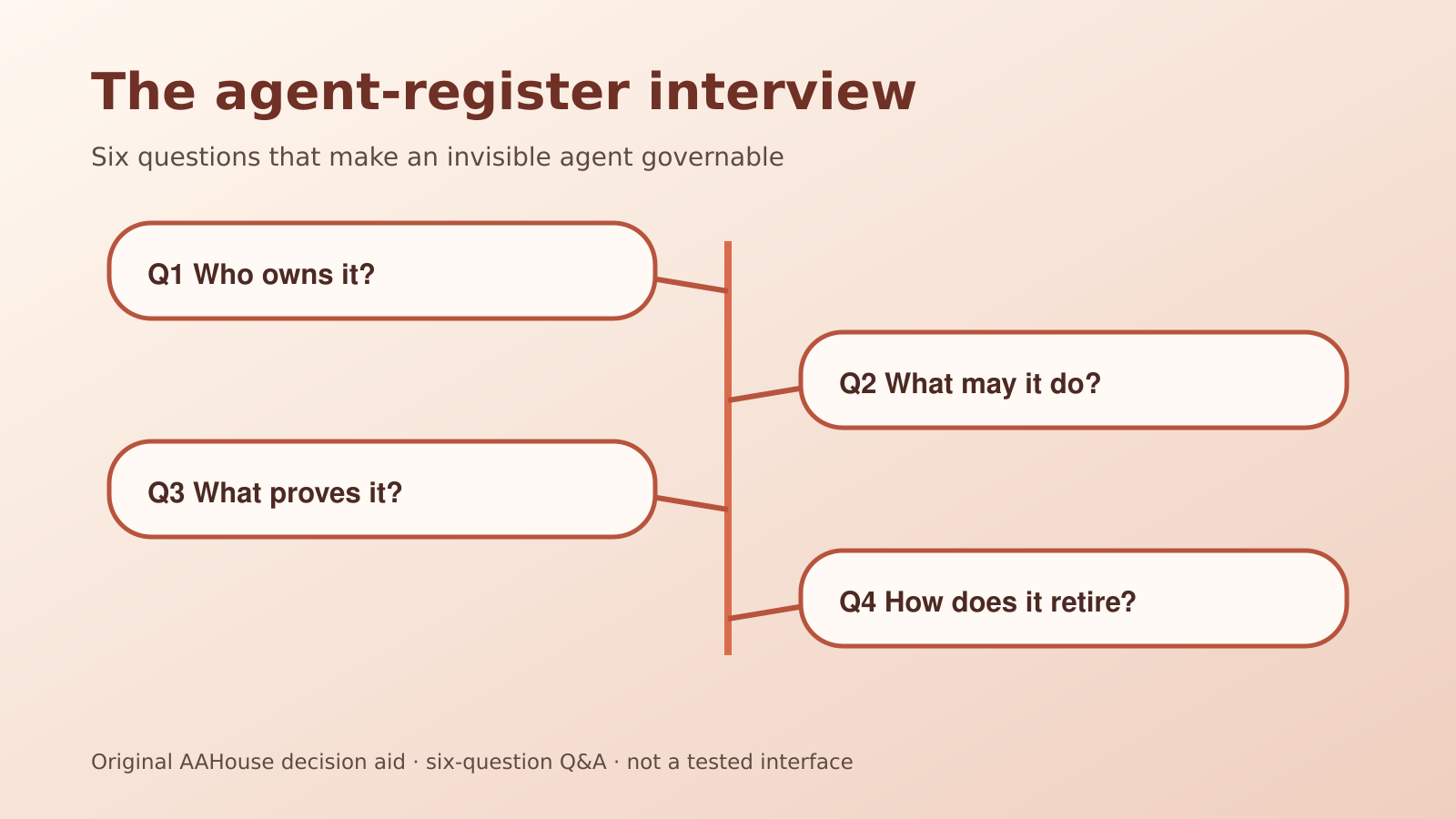
Original AAHouse format-specific decision aid; conceptual, not a tested interface.
Microsoft’s October 27 platform announcement describes Agent 365 as a way to provide agents with identity, access control, observability and governance. In the same announcement, Microsoft says KOHLER employees built more than 3,000 agents and that hundreds were actively used each day. Those figures are vendor-reported and are not an independent measure of business value, but they illustrate how quickly employee-created agents can become a population rather than a handful of experiments. [1]
AWS’s October 7 guidance on building a business case for agentic automation makes a related point: hours saved are not enough. A useful case links an agent to a workflow outcome, defines where autonomy is bounded, and considers auditability and ownership across the lifecycle. [2]
Its October 15 trust-in-depth article also distinguishes precise rules from judgment calls and warns that excessive human review can create its own fatigue. The practical goal is not to route every step to a person. It is to make the agent’s authority, evidence and escalation points visible enough that the right decisions reach the right owner. [3]
Q2 — What belongs in the register?
An agent register is a private operating record, not a marketing catalog. Give every meaningful agent a stable identifier and record at least:
- Business purpose and accountable owner. What workflow does it support, and who can approve changes or shut it down?
- Trigger and inputs. Does it run on demand, on a schedule or after an event? Which records, messages or documents can it read?
- Authority. Can it only read, can it prepare a draft, or can it commit an action such as sending, ordering or updating a system?
- Systems and credentials. Which services can it reach, and is access tied to a managed service identity rather than the builder’s personal account?
- Evidence. Which fictional tests, acceptance cases and failure scenarios were run for the current version?
- Lifecycle state. Is it a pilot, active, paused or retired? When is its next review?
- Stop and recovery path. Who receives an alert, how is the agent disabled, and what must be checked or rolled back afterward?
This register is an original AAHouse recommendation. It does not replace the technical controls described by Microsoft or AWS. It gives a small team a durable management layer while those controls and the agent portfolio evolve.
Q3 — What happens when an agent is orphaned?
Imagine a 12-person industrial-parts distributor. Employees have created three internal agents: one sorts the shared inbox, one drafts quotes from an approved price list, and one flags low stock for a buyer.
The quote agent’s builder leaves the company. The agent still runs, but its connection uses the former employee’s account, nobody owns its exception queue, and the price-list test was never updated after a supplier change.
The problem is not that the agent is employee-built. The problem is that the business has no ownership transfer.
With a register, the departure checklist exposes the orphan immediately. The operations lead pauses the agent, replaces the personal connection with an approved identity, assigns a new owner and reruns tests against fictional quotes before reactivation. If no one accepts ownership, the agent remains disabled and is retired.
This example is hypothetical. It is a control scenario, not a reported customer result.
Q4 — Is this an employee record?
An agent register should not become a hidden employee-surveillance system. Avoid ranking people by prompt volume, number of agents created or automation “productivity.” Those numbers can reward unnecessary automation and discourage the reporting of failures.
The register should describe the operational object: its purpose, version, access, evidence, decisions and owner. Access to the register itself should be limited because it may reveal internal systems and workflows. Customer content, credentials and raw prompts generally do not belong in a broad inventory record.
Q5 — What should approval identify?
A lightweight lifecycle can be enough:
- Propose: name the owner, workflow, authority and intended evidence.
- Pilot: use fictional or safely isolated data; keep irreversible actions behind human approval.
- Activate: approve one exact version and record its access, tests and recovery plan.
- Review: examine failures, overrides, stale connections and whether the workflow still needs an agent.
- Pause or retire: revoke access, stop triggers, preserve the decision record and verify that queued work is resolved.
Do not let “temporarily paused” become an indefinite state with live credentials. Set a review date and a retirement owner.
Q6 — Which measures matter?
Early measures should show whether the portfolio is manageable:
- percentage of active agents with a named owner and recent review;
- percentage using managed rather than personal identities;
- time required to disable an agent and locate affected work;
- number of unresolved exceptions and stale connections; and
- percentage of agents retired because the workflow changed or the value was not demonstrated.
These are proposed operating measures, not published performance results. A high retirement rate can be healthy if it shows that the company is pruning experiments instead of accumulating unattended automation.
A platform can strengthen identity, observability and policy enforcement. But it cannot decide who accepts accountability for an agent’s business purpose. Write that ownership down first. Then the platform has something real to govern.
Original AAHouse analysis, prepared October 28, 2026. AI-assisted writing and original conceptual illustration; approved format-diverse edition. Examples are hypothetical. No hands-on product testing or full video viewing was performed.
Sources and further reading
- The platform approach to becoming FrontierThe platform approach to becoming FrontierMicrosoft · Documentation ·
- Beyond hours saved: Building the business case for agentic automationBeyond hours saved: Building the business case for agentic automationAWS Machine Learning Blog · Documentation ·
- Trust in depth: Giving agents more autonomy without losing controlTrust in depth: Giving agents more autonomy without losing controlAWS Machine Learning Blog · Documentation ·
Editorial approach
AI-assisted original writing, checked against linked public sources. Practical recommendations and illustrative scenarios are editorial analysis, not reported client results. Source dates and product details may differ from this collection’s preparation date.