
Operations · Guide
Trace one customer request across an AI workflow
Use a shared request identity to distinguish model latency from queue and integration delays.

A slow assistant may not be a slow model
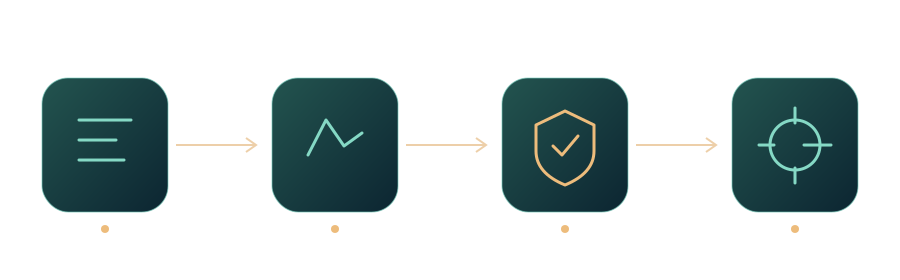
In an illustrative maintenance workflow, staff wait for a classification and blame inference time. A trace may instead reveal minutes in a queue or a connector waiting for a response. Map the request’s journey before tuning the model: intake, validation, retrieval, inference, approval, external action, and confirmation. Decide which intervals matter to the customer, especially elapsed time from submission to a useful next step.
Choose a small trace contract
OpenTelemetry provides a trace model for connected operations. Our recommendation is to carry a correlation identifier through asynchronous messages and record bounded spans around expensive stages. Add status and configuration version rather than raw customer text. Distinguish waiting for human approval from system processing, because reducing the latter will not automatically shorten the former. Sampling should preserve enough failed examples for useful diagnosis without treating every payload as telemetry.
Workflow at a glance
Design a user-visible timeline
Give staff a simpler view: received, checking details, waiting for review, updating the service system, or needs attention. Link support to the technical trace behind that view. Avoid showing completed when only inference finished. Use the external record confirmation as the relevant checkpoint for a write. A coherent timeline reduces duplicate submissions caused by uncertainty and makes manual escalation easier to coordinate.
Tune the bottleneck you observe
Exercise the system with a delayed worker, a slow provider, and an approval backlog. Compare stage distributions and the longest unresolved requests rather than only averages. Then change one constraint at a time, such as concurrency or reviewer coverage. Tracing adds cost and complexity, so begin with the path that matters most. A detailed trace explains timing; it does not establish that the generated answer is accurate or the action was authorized.
A shared incident reference
Show a harmless support reference so employees can report a slow task without pasting documents into chat. Link it internally to the trace, and ask for that reference before requesting more context. The reference identifies an event; it must not itself become authority to read the record.
Sources and further reading
- TracesTracesOpenTelemetry · Documentation ·
Editorial approach
AI-assisted original writing, checked against linked public sources. Practical recommendations and illustrative scenarios are editorial analysis, not reported client results. Source dates and product details may differ from this collection’s preparation date.