
Strategy · Guide
Write a one-page AI pilot charter
Prevent scope drift by agreeing on a decision, a boundary, and a fallback.

State the business decision
A pilot charter should tell a reader what decision the project will inform. For example, will a reviewed intake summary reduce total handling effort enough to justify rollout? This is stronger than announcing a successful AI experiment. Include the process owner, the participating users, the baseline, and the person who can accept the result. Treat those roles as operational commitments rather than administrative decoration.
Draw the boundary
Specify one input channel, a defined user group, and a limited set of outputs. An illustrative agency might test only standard client briefs and exclude contracts or unusual pricing requests. Record exclusions as carefully as features. NIST risk management guidance emphasizes context-sensitive decisions; our recommendation is to make the context visible enough that a later reader cannot mistake a narrow pilot for universal approval.
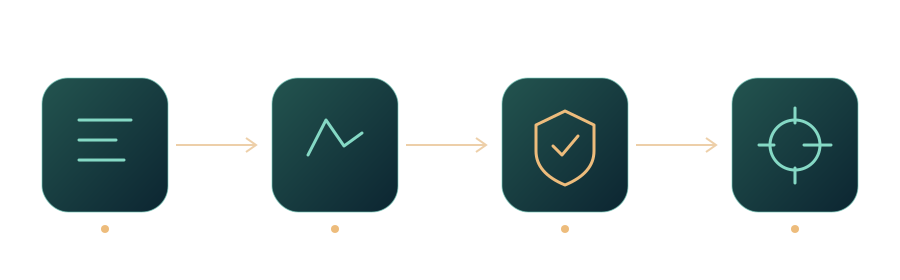
Workflow at a glance
Agree on evidence and effort
Define how many representative tasks will be observed without pretending that a small sample settles every question. Record review minutes, corrections, exception frequency, and support effort. Add a maximum budget or effort envelope and a rule for approving changes. Otherwise, a team can improve the demo indefinitely while losing the ability to tell whether the improvement is economically sensible.
Write the stop and return path
A charter is incomplete without the fallback. Explain how staff resume the previous process, which records remain authoritative, and who is notified when testing stops. Set a review date and choose among stop, revise, or proceed. If no clear benefit appears, a documented decision not to deploy is a useful result. The pilot has answered its question rather than failed its marketing story.
A charter review question
Give the charter to someone outside the project and ask what would count as done. If that person cannot explain the boundary and decision, revise the language. Then ask the operator what happens tomorrow if the test stops. Those two questions reveal different gaps: ambiguous acceptance and an unusable fallback. Resolve both before treating the charter as a reliable agreement.
Sources and further reading
- AI RMF Playbook: ManageAI RMF Playbook: ManageNIST · Documentation ·
- NIST AI RMF Playbook FAQsNIST AI RMF Playbook FAQsNIST · Documentation ·
Editorial approach
AI-assisted original writing, checked against linked public sources. Practical recommendations and illustrative scenarios are editorial analysis, not reported client results. Source dates and product details may differ from this collection’s preparation date.