
Strategy · Guide
Choose your first AI workflow before choosing a tool
A practical way to narrow a broad AI ambition into a testable business improvement.

Start with the work
Ask the team to describe a recent delay, not a desired feature. Follow one request from arrival to completion and list the people, systems, and decisions involved. OECD research treats adoption readiness as a combination of capabilities rather than a software purchase. Our practical interpretation is to select a task whose inputs, owner, and completion condition can be observed.
Compare three candidates
An illustrative service company might compare proposal drafting, invoice approval, and client intake. Score each for frequency, frustration, available examples, review effort, and integration difficulty. Do not collapse these into an apparently scientific score without discussing the tradeoffs. A less frequent task can still win when its delays affect a client deadline and its scope is easier to control.
Workflow at a glance
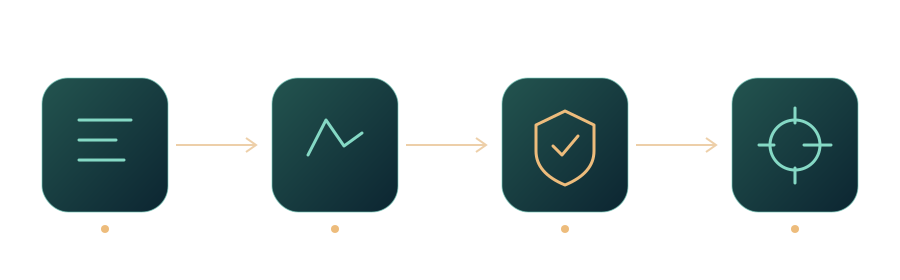
Define one finish line
Write a small outcome statement: a staff member receives a reviewed intake summary with missing fields flagged. Specify what remains manual, what the assistant cannot approve, and how failures return to the existing process. Test against the same examples using a checklist or existing software feature. The comparison should include a simpler non-AI option, not only competing model brands.
Set the next decision
Agree on a short observation period and record both useful outputs and exceptions. At the review meeting, decide whether to stop, revise, or expand that workflow. Avoid attaching platform ambitions to the pilot. The first project should produce evidence about one business problem; it does not need to prove that the company can automate everything.
A worksheet for the first meeting
Before the meeting, draw five boxes: input, owner, decision, output, and exception. Fill them using one recent task and mark every unknown. Then ask which unknown could be resolved cheaply this week. The exercise is intentionally modest. It makes the first conversation about a shared piece of work rather than a contest between vendor presentations or the ambitions of different departments.
Sources and further reading
- AI adoption by small and medium-sized enterprisesAI adoption by small and medium-sized enterprisesOECD · Research source ·
- SME AI Readiness ToolSME AI Readiness ToolOECD · Research source ·
Editorial approach
AI-assisted original writing, checked against linked public sources. Practical recommendations and illustrative scenarios are editorial analysis, not reported client results. Source dates and product details may differ from this collection’s preparation date.