
Data · Analysis
When the diagram carries the instruction, text-only retrieval is incomplete
Treat visual evidence as a separate data-readiness and evaluation problem.

Look for meaning outside paragraphs
A process arrow, warning icon, or chart legend can change how a page should be understood. Sample documents for information that disappears when copied into plain text. Layout and parsing documentation describes ways to retain structure, but a technical capability does not prove that every diagram is understood. Ask the content owner which visual elements change an employee’s decision and which are decorative.
Create a visual dependency test
For an illustrative equipment-service guide, include a question whose answer depends on an arrow direction or a label beside a diagram. Compare the original page, extracted text, and any generated image description. Mark where meaning is lost or invented. Do not accept a generic description such as a workflow chart when the actual task requires choosing one branch. A reviewer should be able to locate the supporting visual region.
Workflow at a glance
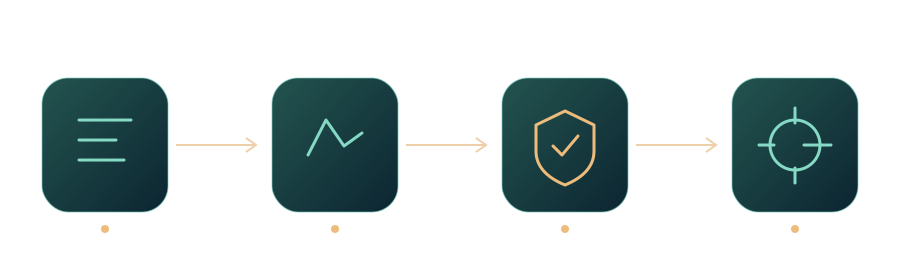
Choose the least fragile representation
Sometimes an approved textual explanation of the diagram is easier to maintain than repeated visual interpretation. In other cases the original image must remain available. Keep the diagram version and its explanation linked, and update both when the process changes. Avoid letting an automatically generated caption become authoritative without review. For consequential instructions, use a human-approved source and preserve a clear manual path.
Evaluate more than visual fluency
Measure whether the employee reaches the correct action, not whether the model writes an impressive image summary. Include changed labels, low-resolution scans, and similar-looking diagrams with different meanings. Count processing and review costs separately from ordinary text retrieval. A multimodal workflow is justified when the selected evidence and operating controls solve a real gap; it should not be added merely because the latest model accepts images.
A content-authoring improvement
If a critical instruction exists only in an ambiguous diagram, ask whether the document itself should be improved for people. Add a reviewed textual explanation and compare both human and AI use. Sometimes better source authoring solves the problem more reliably than an increasingly complicated visual interpretation pipeline.
Sources and further reading
- Parse and chunk documentsParse and chunk documentsGoogle Cloud · Documentation ·
- Retrieval-Augmented Generation with Azure Document IntelligenceRetrieval-Augmented Generation with Azure Document IntelligenceMicrosoft · Documentation ·
Editorial approach
AI-assisted original writing, checked against linked public sources. Practical recommendations and illustrative scenarios are editorial analysis, not reported client results. Source dates and product details may differ from this collection’s preparation date.