
Operations · Guide
Alert on stuck customer work, not every model exception
Connect operational alerts to a person and an action before adding more dashboards.

An exception is not always an incident
An illustrative classifier retries a transient request successfully but sends three alerts along the way. Meanwhile an approval waits two days without anyone noticing. Define alerts around business harm: oldest unresolved request, repeated connector failure, unexpected external action, or missing recovery ownership. CloudWatch documents metric and composite alarms; the meaningful thresholds and response duties must come from the workflow’s service expectations.
Write the response before the rule
For every alert, identify the first responder, safe diagnostic view, permitted immediate action, and escalation route. A message that says model error without a request reference is not actionable. Distinguish urgent containment from a next-business-day investigation. Use synthetic events to verify delivery and avoid including customer documents in alert payloads. An alarm that reaches an abandoned mailbox is equivalent to no useful response path.
Workflow at a glance
Use a small operational scorecard
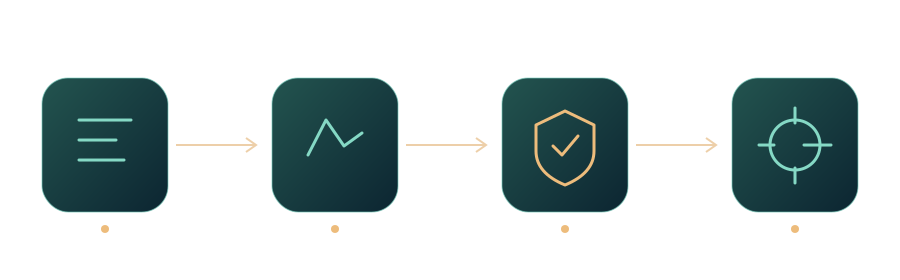
Begin with a small set: unresolved request age, external-action confirmation rate, review backlog, failed-job count, and recovery time. Group symptoms from one outage to avoid flooding responders. Investigate the leading signal before changing thresholds. A rising queue may indicate provider latency, intake growth, or missing reviewers; an automatic scaling response is not appropriate for every cause. Human context remains important even in highly automated operations.
Review noise as a cost
During a pilot, classify each alert as useful action, duplicate, false alarm, or missing context. Track response effort and unresolved outcomes. Remove or redesign noisy rules only after checking that the underlying risk remains covered. A quiet dashboard is not proof of reliability, and a busy dashboard is not proof of good monitoring. The evidence is whether the right person discovers and resolves affected work within the agreed operating window.
Agree operating hours
State whether alerts receive business-hours or continuous attention and provide an urgent incident route where appropriate. An automated overnight message does not imply human monitoring. Higher coverage needs staffing and handover investment; increasing notification frequency is not a substitute for an agreed service response.
Sources and further reading
- Using Amazon CloudWatch alarmsUsing Amazon CloudWatch alarmsAWS · Documentation ·
- TracesTracesOpenTelemetry · Documentation ·
Editorial approach
AI-assisted original writing, checked against linked public sources. Practical recommendations and illustrative scenarios are editorial analysis, not reported client results. Source dates and product details may differ from this collection’s preparation date.