Operations · Guide
After the AI quote, the amount still needs a unit contract
Eight review questions separate currency, precision, rounding, and interface values.
After the AI quote, the amount still needs a unit contract
Original AAHouse explanatory video. AI-assisted conceptual visuals and neural narration; original music.
Simplified Chinese Mandarin transcript · English transcript · Taiwan Mandarin transcript · Hong Kong Cantonese transcript · Macao Cantonese transcript
Is one number enough?
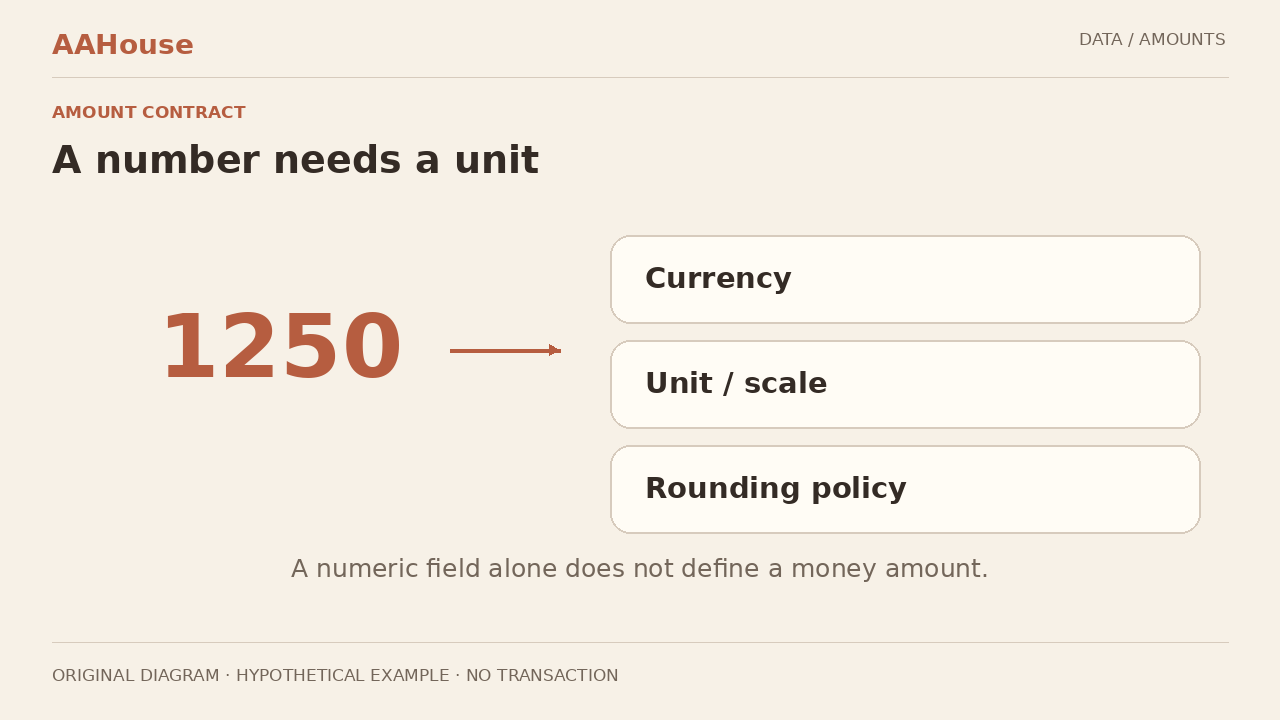
No. Imagine a U.S. service business using AI to organize draft quotes before an approved amount moves to another system. The number 1250 alone does not identify its currency, unit, or decimal scale. This design Q&A follows representation, not pricing authority, tax policy, or investment decisions. It is a hypothetical software review, not a reported customer incident. No payment is performed, and the examples are not instructions to charge a customer.
Can we just multiply by one hundred?
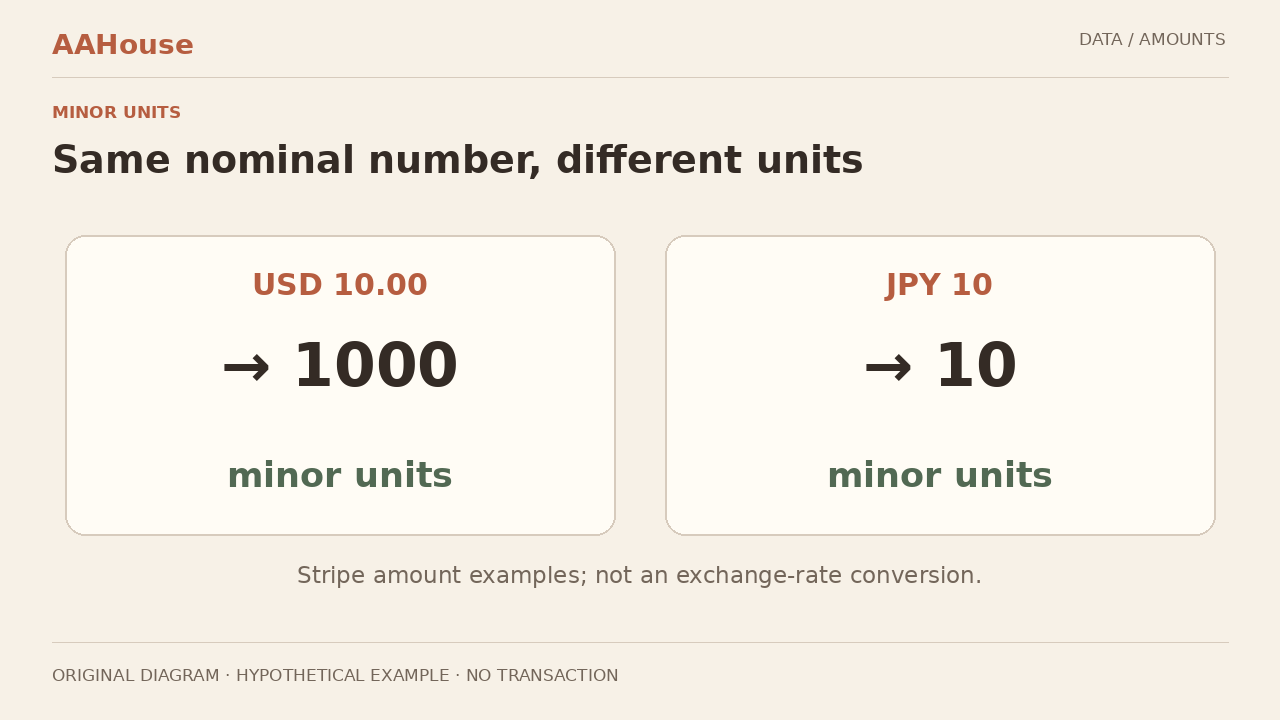
Not as a universal rule. Stripe documents amounts in minor units: ten U.S. dollars maps to 1000, while ten Japanese yen maps to 10.[1] This describes representation, not an exchange rate. Put both examples in the adapter tests to expose a hard-coded multiply-by-one-hundred assumption. Check the particular operation, supported currency, and limits separately. A value that is correctly encoded is not automatically an allowed transaction.
Does a numeric field settle precision?
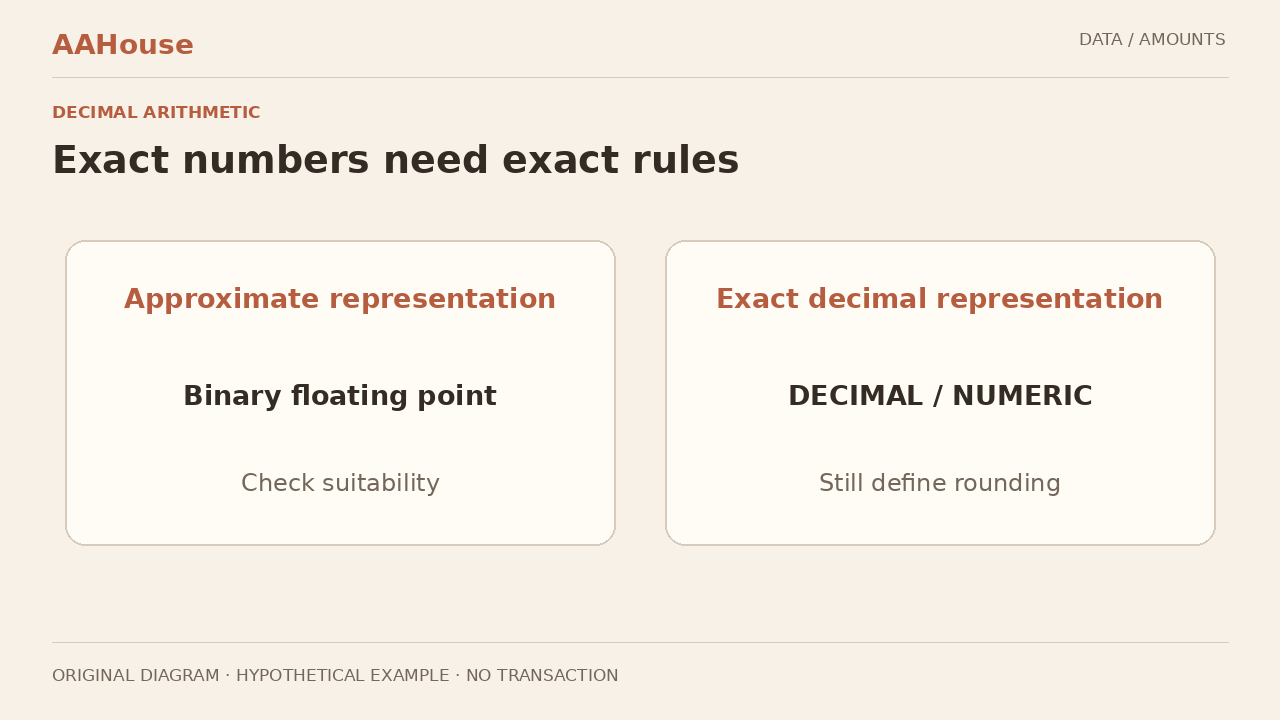
Check the type and scale. PostgreSQL distinguishes exact numeric values from inexact floating-point types, and a declared scale can round an incoming value.[2] Our recommendation is to define input and calculation precision before choosing storage. Displaying two decimal places does not establish that an intermediate calculation preserved precision. An integer-minor-unit field can suit a bounded interface, while fractional intermediate calculations still need an explicit representation and conversion rule. Also specify the supported range at every boundary; a value may fit one system but exceed another’s limits.
When should rounding happen?
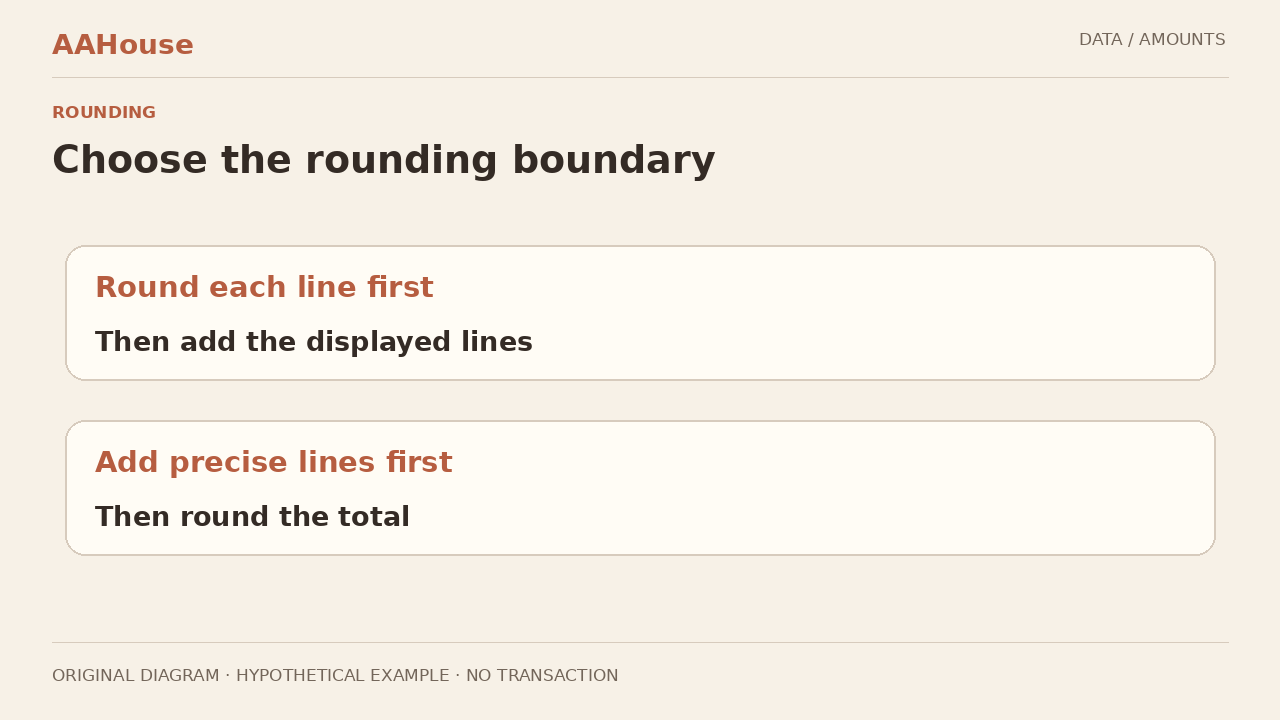
The business rule should answer that question explicitly. Rounding each line before adding can differ from rounding a total afterward. Do not let a model or an incidental database default select the policy. Record the rounding mode, the stage where it applies, and the rule version. Where tax or contractual requirements determine the answer, ask the responsible specialist. This article proposes a software control, not the appropriate commercial or legal rounding policy.
Does a new symbol convert the amount?
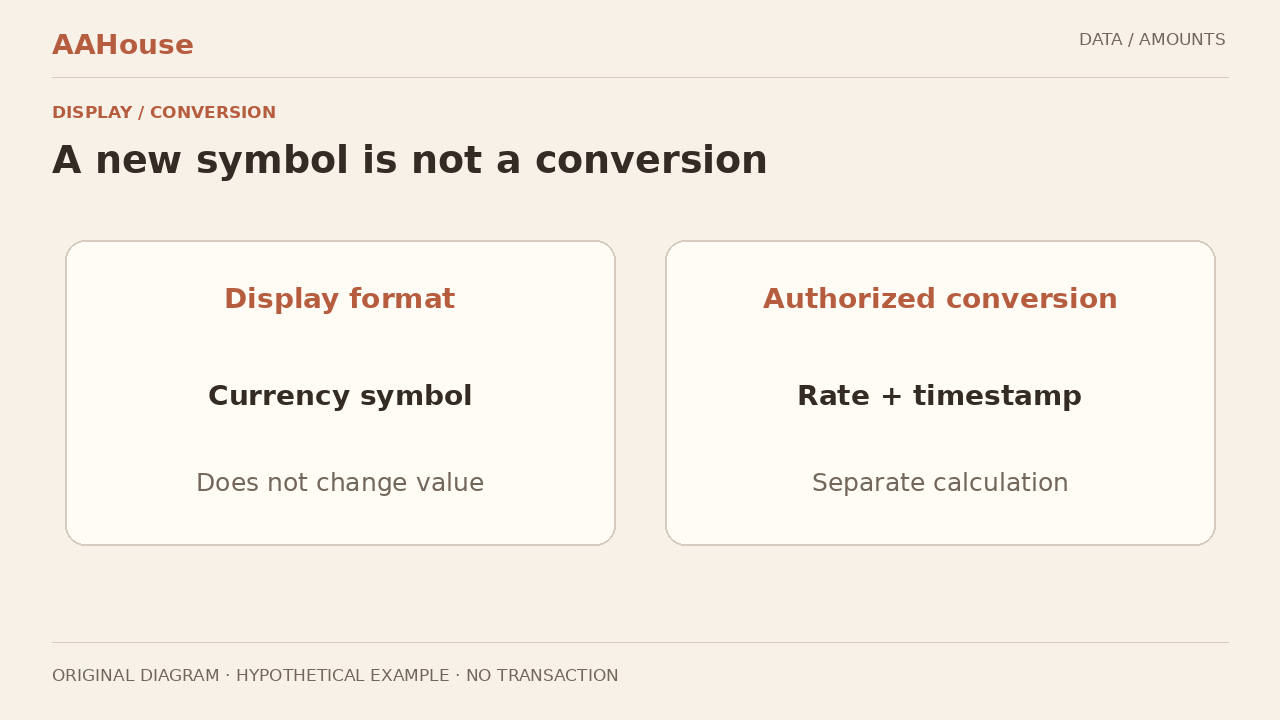
No. Treat presentation and currency conversion as separate operations. Replacing a dollar symbol with a yen symbol changes the reader’s interpretation without supplying an exchange-rate basis. If conversion is actually part of the authorized workflow, record its approved rate source, timestamp, and resulting amount as a separate step. Otherwise retain the original currency and expose the unresolved choice. A localized interface should never silently redefine the commercial value it displays.
Can AI fill in a missing currency?
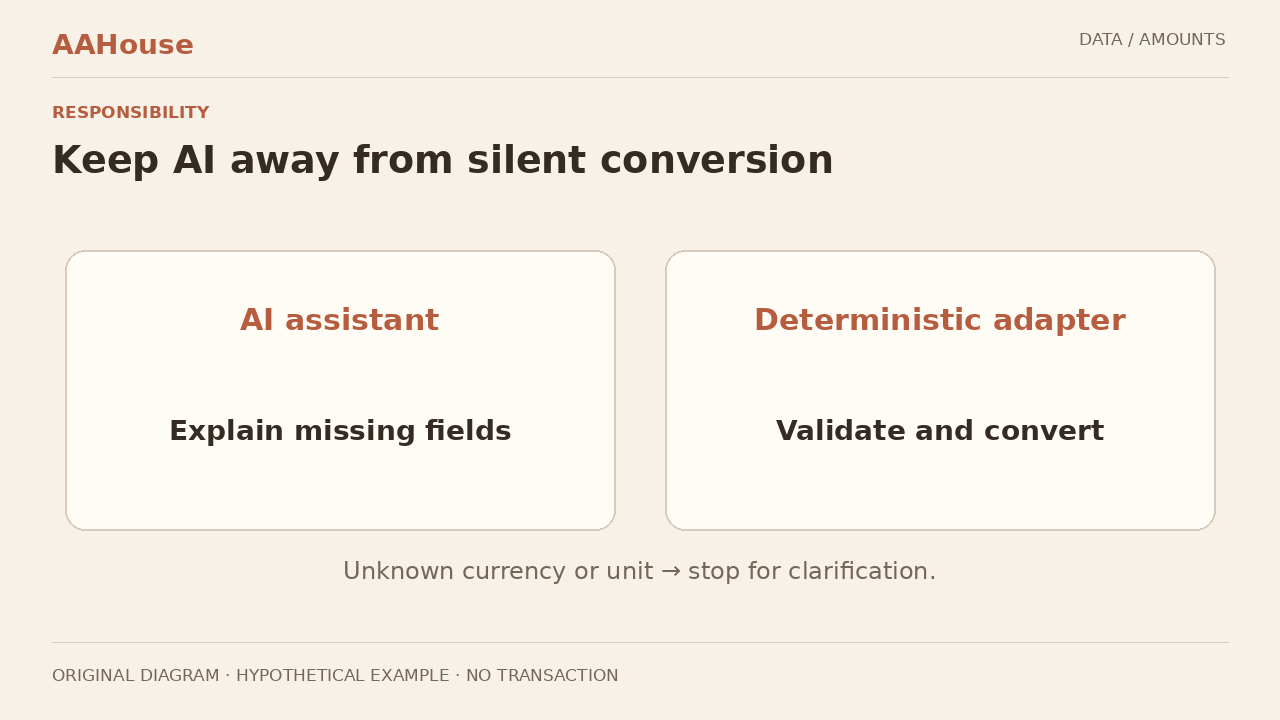
It can surface clues, but should not silently resolve the missing business fact. We recommend blocking an unknown currency, unexpected precision, or unsupported operation until the owner resolves it. Keep the source text, normalized amount, and interface integer traceable to one another. The review screen should show a readable amount with its currency, not only a technical integer or an ambiguous symbol. A structurally valid response from a model is not enough evidence. Preserve corrections and their reasons, so a display-only change cannot conceal a different interface value.
What should acceptance compare?
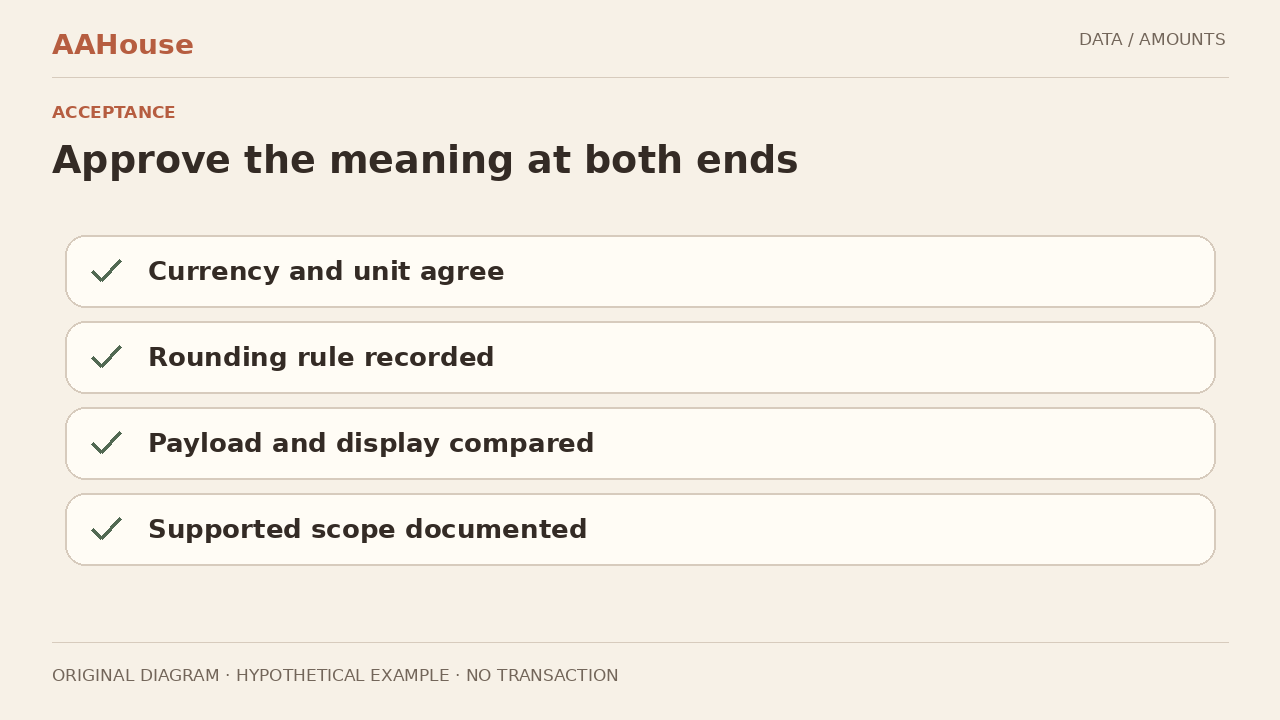
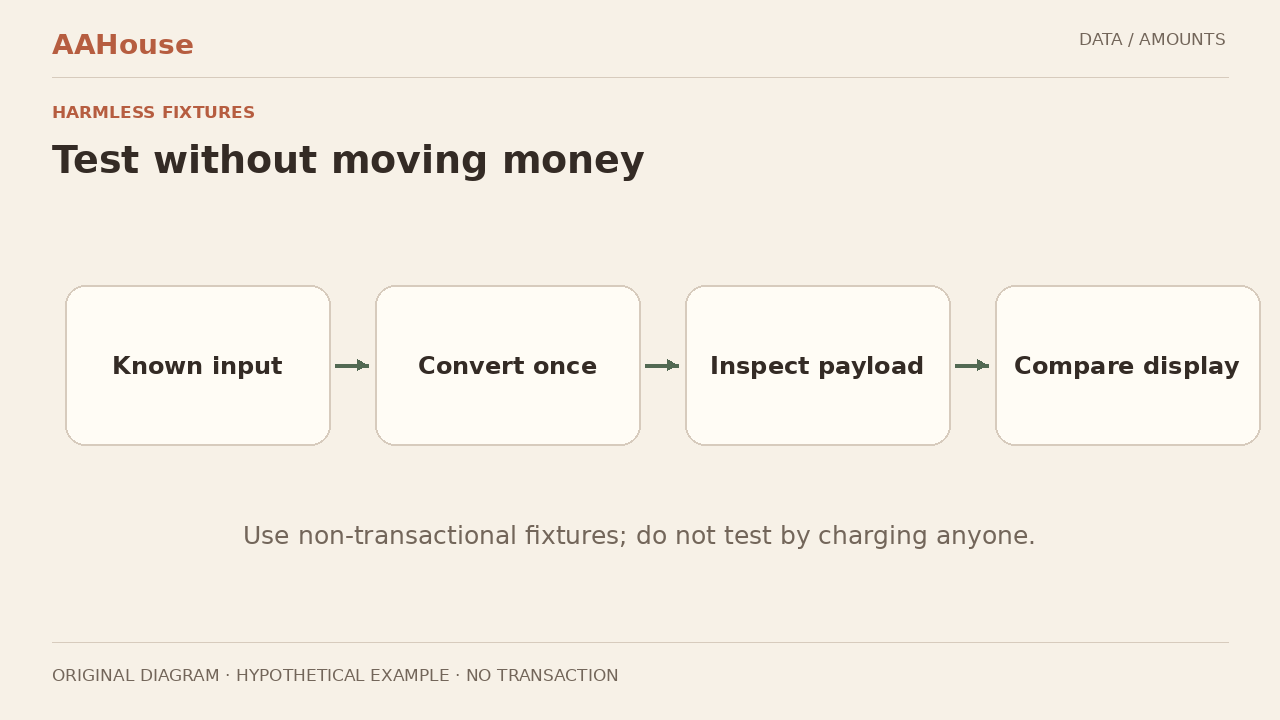
Compare the complete path, not only a screenshot. Use invented values covering two-decimal and zero-decimal currencies, rounding boundaries, zero, permitted negative values, and out-of-range input. Verify parsing, calculations, storage, interface encoding, and final display. Write the expected pass or block outcome before execution. Run these checks in an isolated test environment without creating real charges. This article describes a test plan; it does not claim the target integration has passed it.
What should the team keep?
Keep a compact amount contract naming field meaning, allowed currencies, precision, rounding rule, destination interface, and exception owner. Maintain its fixtures with the adapter and rerun them after interface or policy changes. The outcome is an explainable path from the approved business amount to the system parameter. Fewer reconciliation surprises are a goal to measure later, not a result this hypothetical walkthrough claims to have achieved.