
Strategy · Guide
AI Can Remember Your Brand—But Your Team Still Needs a Source of Truth
Small businesses are being offered a helpful new promise: give an AI your website, colors, fonts and connected business context, and it can produce work that feels more like your company. That can remove repetition. It can also hide a new kind of drift. If the AI “remembers the brand,” people may stop asking which source was current, who approved a change, or whether a campaign exception quietly became a permanent rule. The answer is not to avoid brand-aware AI. It is to give the AI—and the team—a versioned source of truth.
AI Can Remember Your Brand—But Your Team Still Needs a Source of Truth
Original AAHouse explanatory video. AI-assisted conceptual visuals and neural narration; original music.
FIELD NOTE — What the new tools promise
Field note: Treat every generated asset as a proposal tied to a named source, not as the newest version of the brand.
| Before | After |
|---|---|
| “The AI remembers our style.” | “The draft used Brand Core v3 and Holiday Brief v1.” |
| Approval lives in chat history. | Approval has an owner, date and version. |
| Exceptions silently become precedent. | Temporary rules expire with the campaign. |
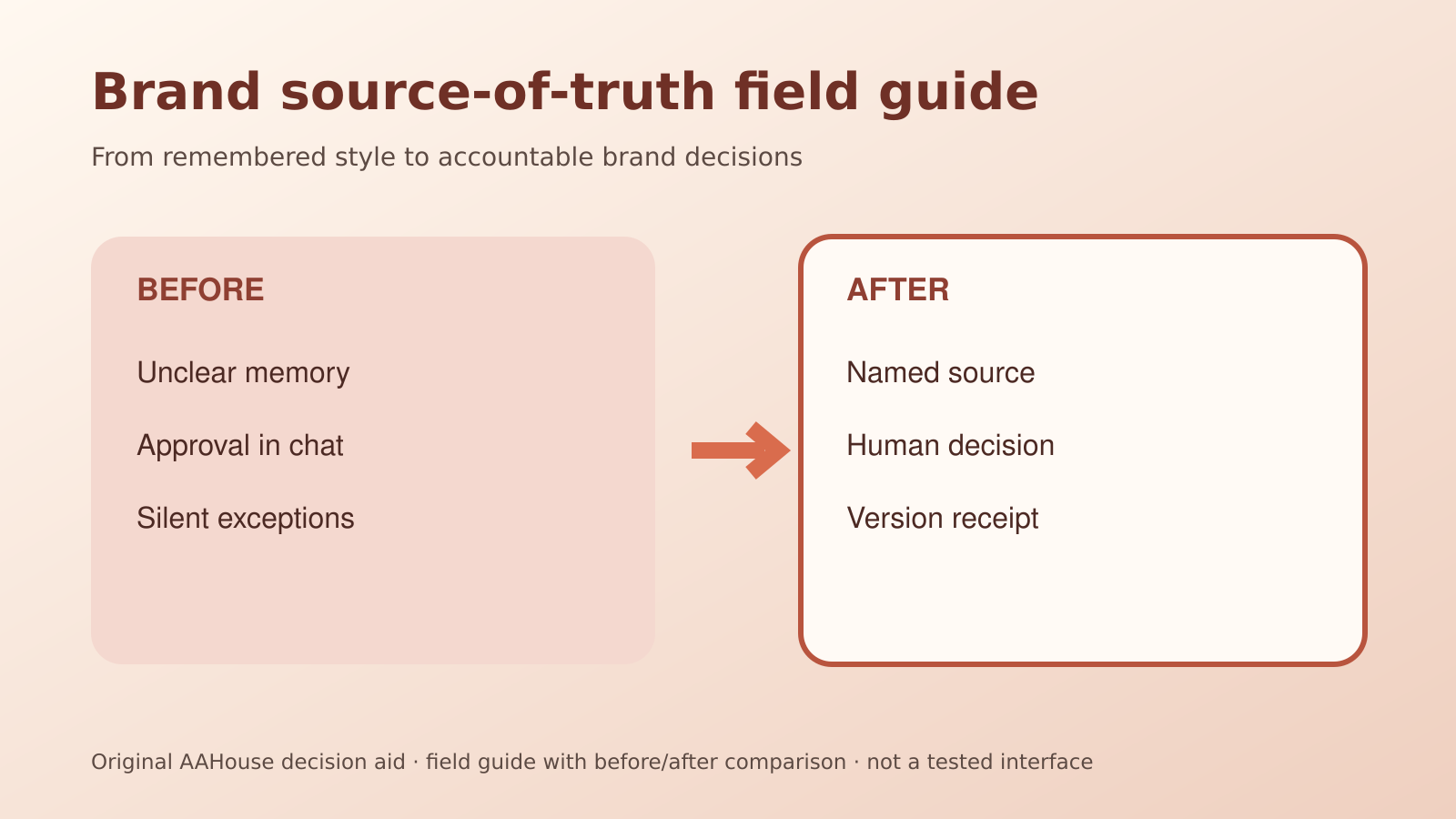
Original AAHouse format-specific decision aid; conceptual, not a tested interface.
On October 20, Google announced a Gemini business hub for small-business owners. Google says owners can provide a website, brand kit, fonts or color palettes, and that Gemini can retain the style while generating visual work. The same announcement describes connections to Google Business Profile, Ads and Workspace, plus third-party applications including Canva, Shopify, Wix and Xero. It also describes tools that turn spreadsheets, receipts and purchase records into financial graphics and interactive models. Google said the business hub, marketing and finance skills, and connected apps were beginning a global rollout in the following days. [1]
Google’s connected-app help page adds useful boundaries. For example, it says the Canva connection can create and edit designs and manage project assets, but cannot manage Brand Kit assets such as uploaded logos, custom fonts or color palettes. It also lists account, activity and regional requirements for some connections. [2]
OpenAI’s September 30 small-business announcement points to the wider adoption context. It reports that about four million small-firm employees used OpenAI tools during one week in September, and it emphasizes hands-on training and choosing a useful starting point. Those are vendor-reported figures and programs, not AAHouse measurements. [3]
These product announcements establish the direction: AI is becoming more connected, brand-aware and operational. The workflow recommendation below is AAHouse’s own analysis.
RULE 1 — Memory is not authority
A model can remember a palette, imitate a tone and reuse a logo. That does not make it the authority on the brand.
The authority should remain a human-owned record that answers four questions:
- What is fixed? Approved name, logo files, colors, typefaces, required disclaimers and words the company does not use.
- What varies by channel? A storefront sign, an email, a marketplace listing and a social post have different size, accessibility and policy constraints.
- What is temporary? A seasonal campaign may use a special color or voice without changing the core brand.
- Who approved the current version? A date, owner and stable version identifier make the decision traceable.
AI should read from this record. It should not silently rewrite it from whatever was generated most recently.
THE FOUR-LAYER KIT
For a practical pilot, separate the instructions into four small objects:
- Brand core: the durable rules and approved assets.
- Channel profile: the constraints for one destination, including dimensions, required fields and publishing permissions.
- Campaign brief: the temporary message, offer, audience and expiration date.
- Output receipt: the exact inputs, generated files, reviewer decision and final destination.
This separation matters when something changes. If a logo is updated, the team can revise the brand core once. If an offer ends, the campaign brief expires without erasing the brand. If a marketplace changes its image requirements, only that channel profile needs revision.
A single “remember everything about us” conversation is easier at first, but harder to audit later.
WORKED EXAMPLE — A bakery launch
Imagine a neighborhood bakery preparing a holiday launch. The owner gives an AI an approved emblem, four colors, two fonts and a short tone guide. The campaign brief says the offer runs for one week and excludes custom cakes.
The AI prepares:
- a storefront poster;
- a social post;
- an email header; and
- a product-card image for an online shop.
Before anything is published, the owner reviews one compact receipt. It identifies Brand Core v3, Social Profile v2, Email Profile v1 and Holiday Brief v1. It also shows that the online-shop image is still waiting because its product description contains an unverified allergen statement.
This example is hypothetical. The useful result is not “four assets in seconds.” The useful result is that the team can tell which rules governed each asset and why one output stopped.
DRIFT SPOTTING GUIDE
Brand drift is not always dramatic. It often appears as small, repeated substitutions:
- a generated shade that is close to—but not—the approved color;
- a friendly phrase that conflicts with a regulated disclaimer;
- a shortened business name that is not allowed on invoices;
- a campaign tagline that remains in use after the campaign ends; or
- a design edited in a connected app after the original approval.
A lightweight check can catch much of this. Compare the output with the specific brand-core version, verify required text separately from the image, and recheck the final file after editing or export. If the output changes after approval, create a new version instead of treating the old approval as transferable.
Do not ask a model to be the only judge of its own compliance. Automated checks can flag colors, dimensions, missing files and required phrases. A person should still decide whether the work represents the business appropriately.
START HERE — One reversible channel
The safest first test is a channel where a draft can be reviewed and replaced easily—such as an internal campaign concept or an unpublished social draft. Avoid starting with automatic publishing, financial claims, health claims or customer-specific promises.
Track a few practical measures:
- time spent restating brand instructions;
- number of outputs returned for brand corrections;
- number of expired campaign elements caught before publishing; and
- time required to identify the exact source and approval behind a final asset.
These are proposed evaluation measures, not reported customer results.
The new tools can make consistent creation easier. A source of truth makes that consistency accountable.
Let the AI remember the style. Keep ownership of the brand.
Original AAHouse analysis, prepared October 28, 2026. AI-assisted writing and original conceptual illustration; approved format-diverse edition. Examples are hypothetical. No hands-on product testing or full video viewing was performed.
Sources and further reading
- New Gemini tools for small business ownersNew Gemini tools for small business ownersGoogle · Documentation ·
- Create designs & build websites with your creative apps in Gemini AppsCreate designs & build websites with your creative apps in Gemini AppsGoogle Gemini Apps Help · Documentation ·
- Helping small businesses put AI to workHelping small businesses put AI to workOpenAI · Documentation ·
Editorial approach
AI-assisted original writing, checked against linked public sources. Practical recommendations and illustrative scenarios are editorial analysis, not reported client results. Source dates and product details may differ from this collection’s preparation date.