
Operations · Analysis
When the AI Keeps Working, Ask for a Handoff Receipt
An employee working while you are away should tell you what finished, what changed, what is waiting, and which decision belongs to you. An always-on AI agent needs the same discipline. A compact six-field handoff receipt gives a business-facing index into the detailed evidence.

The product direction is clear; the operating habit is not
On October 27, OpenAI and Oracle announced plans to connect Oracle applications and data with ChatGPT. The announcement describes approved workflows that can span finance, procurement, and planning, and it introduces an Oracle AI SMB Bundle combining ChatGPT Business, Codex, Oracle applications, and recurring cloud credits. These are announced offerings and intended experiences; this article does not claim that AAHouse tested them or that every feature is generally available today. [1] Other recent announcements point in the same direction. OpenAI describes dots as always-on agents that can use connected applications and continue work in their own cloud computers. Google Cloud describes Gemini agent as persistent across devices and channels, able to work for hours or days and connect with business systems. Availability varies: OpenAI says dots are beginning to roll out in eligible markets, while Google’s October 8 small-business announcement says Gemini was in early access for SMB customers and would become more broadly available later. [2][3] Those are product facts. AAHouse’s editorial conclusion is separate: when work continues outside a person’s direct view, the workflow needs a compact handoff receipt—not merely a chat message saying “done.”
A transcript is not a handoff
Imagine a hypothetical local distributor. Overnight, an agent checks low-stock items, compares open purchase orders, drafts two supplier messages, and notices that one customer order may miss its promised date. In the morning, a raw transcript might show dozens of searches, tool calls, and retries. That can help with technical investigation, but it is a poor operating handoff. The owner needs to know which records were read and how current they were; whether anything was actually changed or only drafted; which supplier messages remain unsent; which customer commitment may be affected; and what decision is needed before a deadline. The detailed log should still exist where appropriate. The handoff receipt is the short business-facing index into that evidence.
Workflow at a glance
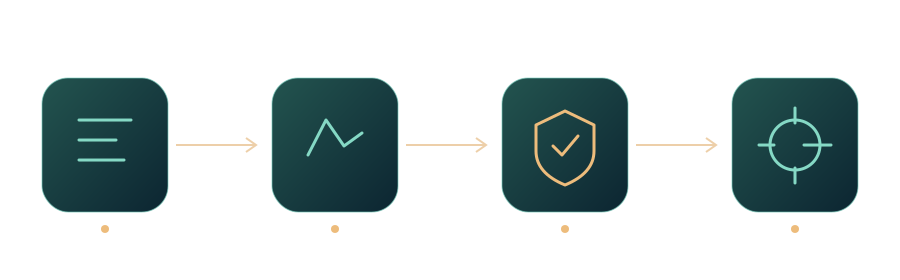
Give every unattended run six fields
For a first pilot, require one receipt at the end of each scheduled or unattended run: • Objective and version: the exact instruction and its active version. • Evidence used: the records, messages and policies, including their freshness. • Completed actions: changes in systems of record, with identifiers or links. • Prepared but not committed: drafts, suggested edits or proposed transactions still waiting. • Exceptions and uncertainty: failures, conflicts, stale data and assumptions. • Next human decision: who must decide what, by when, and what happens without a response. This six-field receipt is an original AAHouse workflow recommendation, not a built-in feature promised by any cited vendor. A business can implement it in an existing task system, database, or structured email before buying a dedicated agent platform.
Make “completed” a narrow word
The most dangerous line in a handoff is often the simplest: “Task completed.” Completed where? In the distributor example, “supplier follow-up completed” could mean the agent found the supplier, drafted a message, queued it, sent it, or received a reply. Those are different business states. The receipt should use verbs that match verifiable records: read, drafted, approved, sent, acknowledged, posted, or reconciled. If a workflow crosses several systems, it may end in partial success. The receipt should say so plainly. For example: “Inventory note posted; supplier email drafted but not sent; customer delivery date unchanged; owner decision due by 10:00 a.m.” That sentence is more useful than a green success badge.
Put approvals beside the action they control
An approval request should identify the exact pending action. “Approve this run” is too broad if the run produced two supplier drafts, a proposed order change, and a customer notice. The owner might approve the supplier drafts while rejecting the order change. Each decision should point to a stable draft or transaction version. If the draft changes after approval, it needs renewed approval. This is especially important when one agent appears in several channels. A reply in chat should not accidentally approve a different draft in email. The handoff receipt should link the decision to the same record the action will use.
Test the morning after, not only the overnight run
Before connecting a pilot to live commitments, use fictional data and inspect the handoff experience. Try four cases: one system is unavailable after another system has already changed; the source record changes while the agent is working; two drafts look similar but contain different prices or dates; and the responsible person does not respond before the deadline. The test passes only if a person can reconstruct the business state without reading the full transcript. They should be able to tell what is safe to continue, what must be checked, and what has not happened. Track receipt completeness, unresolved items found during review, incorrect “completed” labels, and the time required for a human to regain context. These are proposed evaluation measures, not reported customer results.
Start with one quiet workflow
A good first use is a low-risk overnight preparation task: assemble tomorrow’s open items, draft follow-ups, and flag records that need a decision. Keep external messages and financial commitments behind explicit approval. The goal is not to make the AI look busy all night. It is to let the business owner return to a truthful, compact picture of the work. An agent that can continue without you should also know how to hand the work back. *Original AAHouse analysis, prepared October 27, 2026. AI-assisted writing and original conceptual illustration; approved for preview publication. Examples are hypothetical. No product hands-on testing or full video viewing was performed.*
Sources and further reading
- OpenAI expands partnership with Oracle to bring its apps to ChatGPTOpenAI expands partnership with Oracle to bring its apps to ChatGPTOpenAI · News ·
- Introducing dotsIntroducing dotsOpenAI · News ·
- Welcome to Gemini at Work 2026: Introducing the Gemini agentWelcome to Gemini at Work 2026: Introducing the Gemini agentGoogle Cloud · News ·
Editorial approach
AI-assisted original writing, checked against linked public sources. Practical recommendations and illustrative scenarios are editorial analysis, not reported client results. Source dates and product details may differ from this collection’s preparation date.