
Integration · Guide
The AI translation reads well. The order ID no longer fits.
Check translation template fields so fluent text preserves the exact variables required for substitution.
The AI translation reads well. The order ID no longer fits.
Original AAHouse explanatory video. AI-assisted conceptual visuals and neural narration; original music.
English transcript · Simplified Chinese Mandarin transcript · Taiwan Mandarin transcript · Macao Cantonese transcript
A small pair of braces on the review desk
Imagine a U.S. repair shop asking AI to translate an order notification. “Order {order_id} is ready.” becomes Chinese text containing {订单号}. The prose is fluent, but it may no longer accept the order_id supplied by the application. These braces mark an interface between software and copy, not text intended for customers. This is a fictional editing exercise.
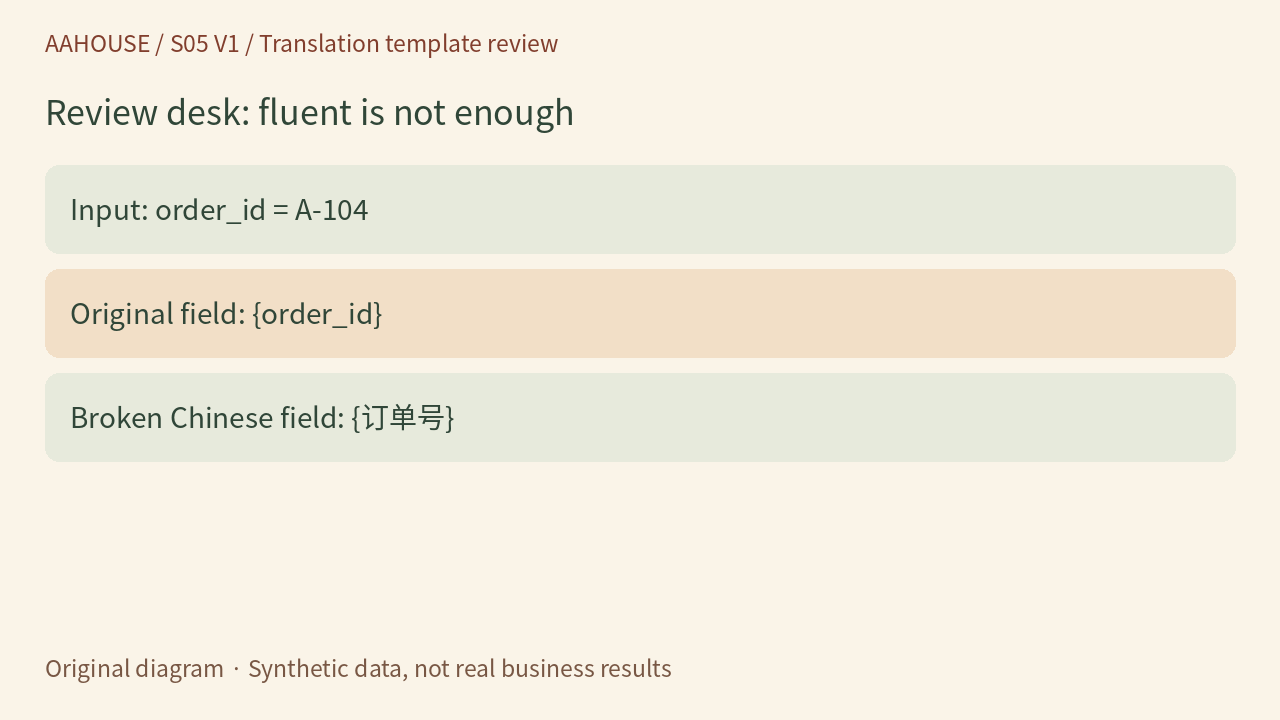
- Input: order_id = A-104
- Original field: {order_id}
- Broken Chinese field: {订单号}
Original diagram · Synthetic data, not real business results
Rejected draft one: the field name was translated
In the Python str.format syntax used for this example, braces enclose replacement fields and names must match the supplied data.[1] In a local synthetic test with ID A-104, the translation retaining {order_id} inserted the ID correctly. Changing the field to {订单号} raised KeyError. That is not a claim about every template engine, but it demonstrates why fluency alone is not software acceptance.
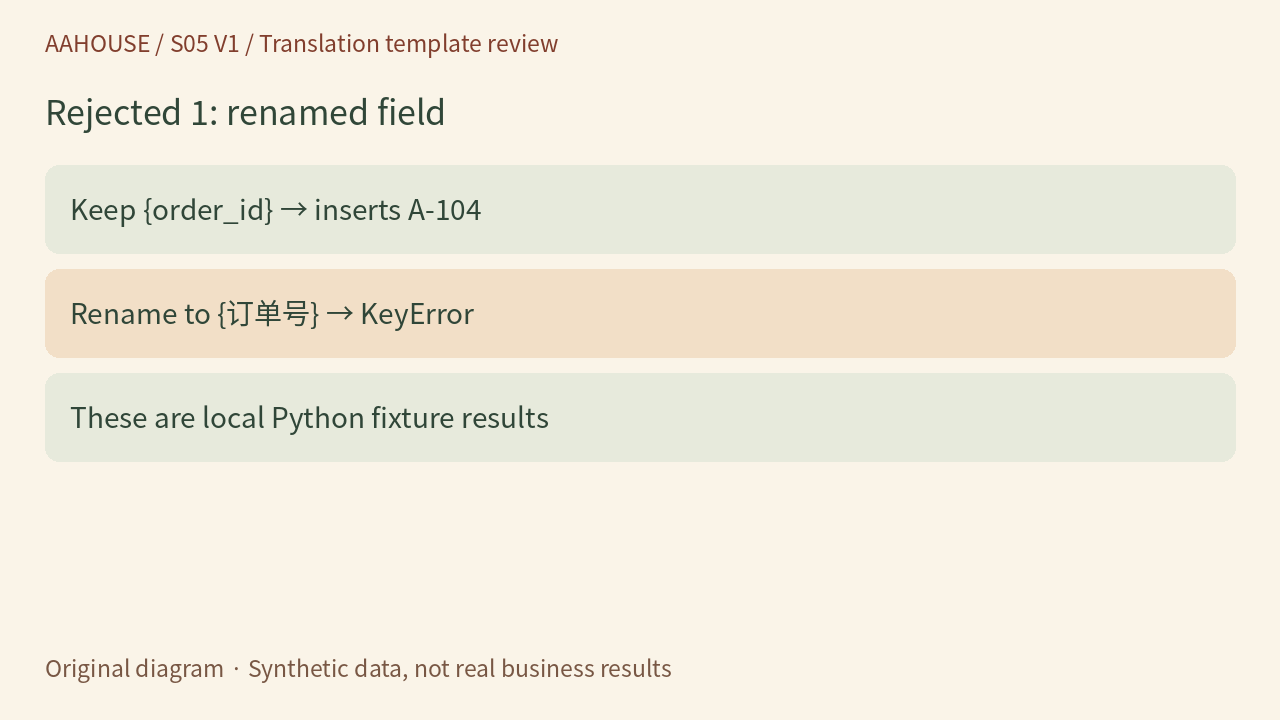
- Keep {order_id} → inserts A-104
- Rename to {订单号} → KeyError
- These are local Python fixture results
Original diagram · Synthetic data, not real business results
Rejected draft two: it runs but loses the ID
A second translation says only “The order is ready.” It has no syntax error, yet omits the identifier the customer needs to distinguish orders. Our local test confirmed it still produces text, so checking only for runtime errors is insufficient. For a simple notification, first list the required fields, then compare parsed fields and rendered output. Presence alone does not prove a field is used in the right place; meaning still needs human review.
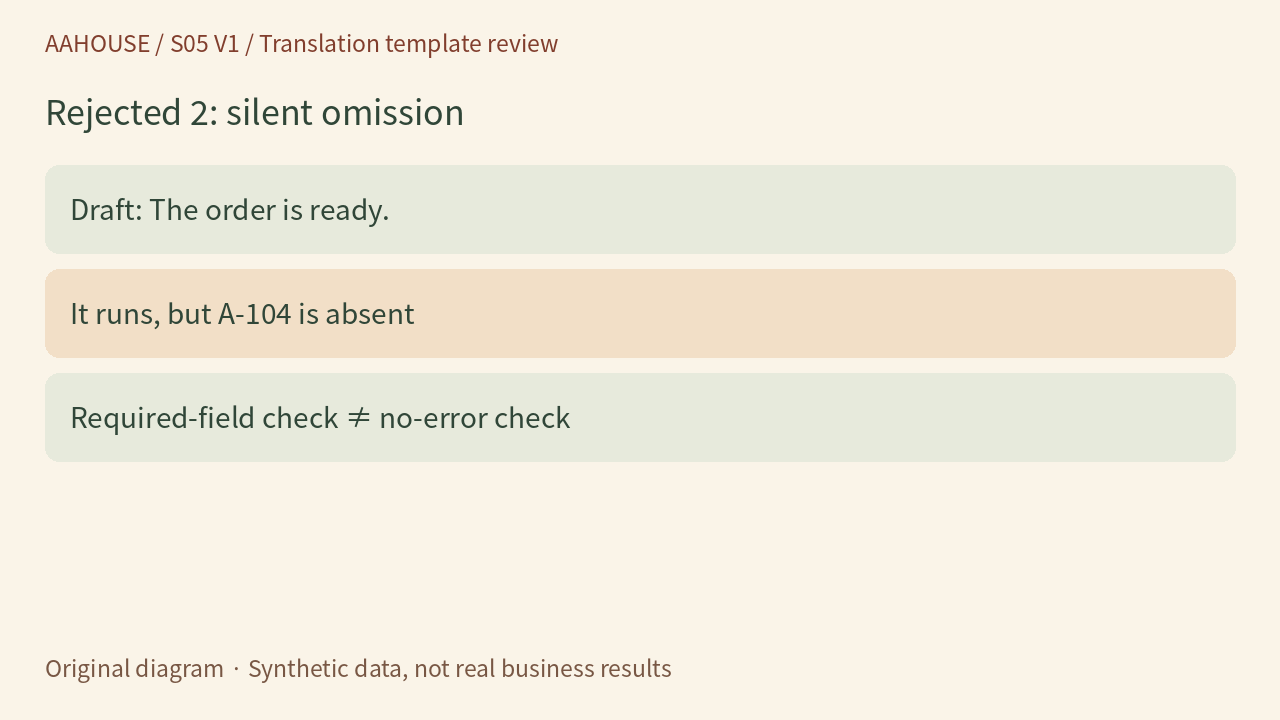
- Draft: The order is ready.
- It runs, but A-104 is absent
- Required-field check ≠ no-error check
Original diagram · Synthetic data, not real business results
Reorder the sentence, not the contract
Preserving field names does not require copying English word order. ICU documentation recommends translating a message as a whole so variables can move with the target language; MessageFormat also supports language-dependent plural selection.[2] Give AI the full sentence, field meanings and example values rather than isolated fragments. Python and ICU syntax are not interchangeable. Validate with the parser actually used by the product.
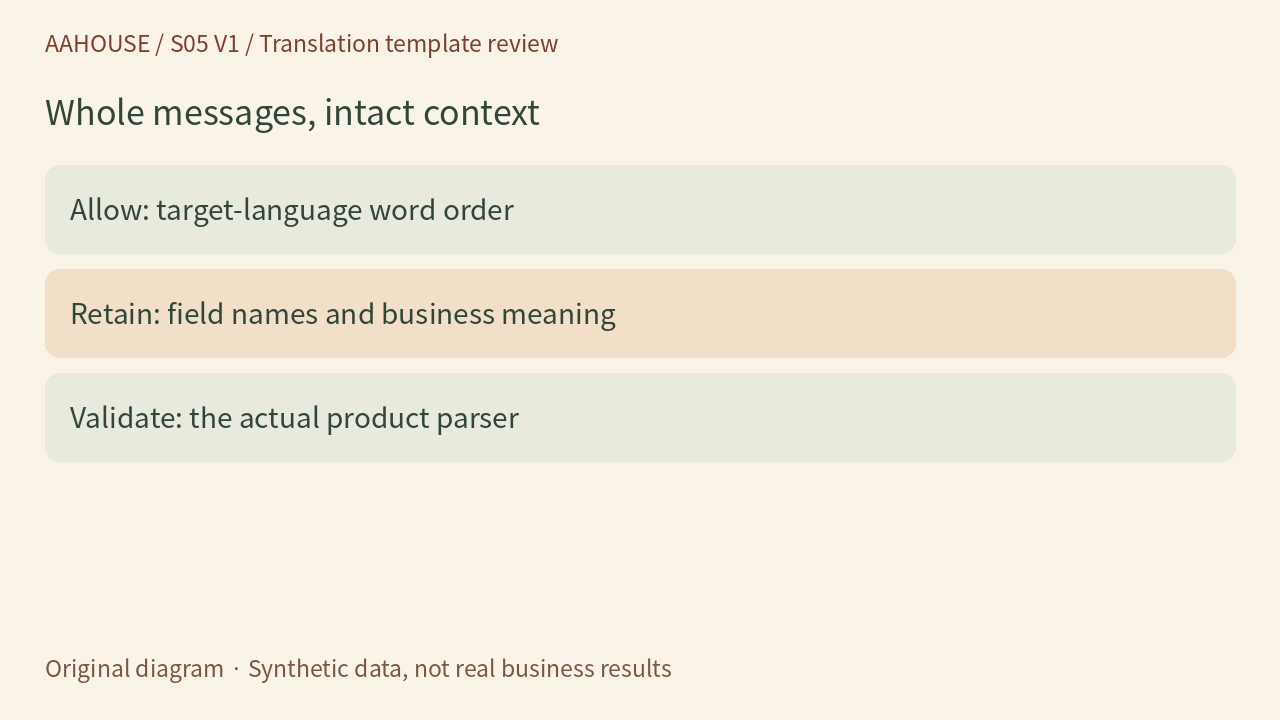
- Allow: target-language word order
- Retain: field names and business meaning
- Validate: the actual product parser
Original diagram · Synthetic data, not real business results
A handoff the reviewer can test
Hand over the Chinese template with its example data. The rendered message should contain A-104 and still say the order is ready. Also test missing data, longer identifiers and the language branches supported by the product. Our recommendation is to record field-contract checks separately from language review; a failure in either keeps the message a draft. This article ran only simple synthetic Python tests, without connecting to a customer system or sending notifications.
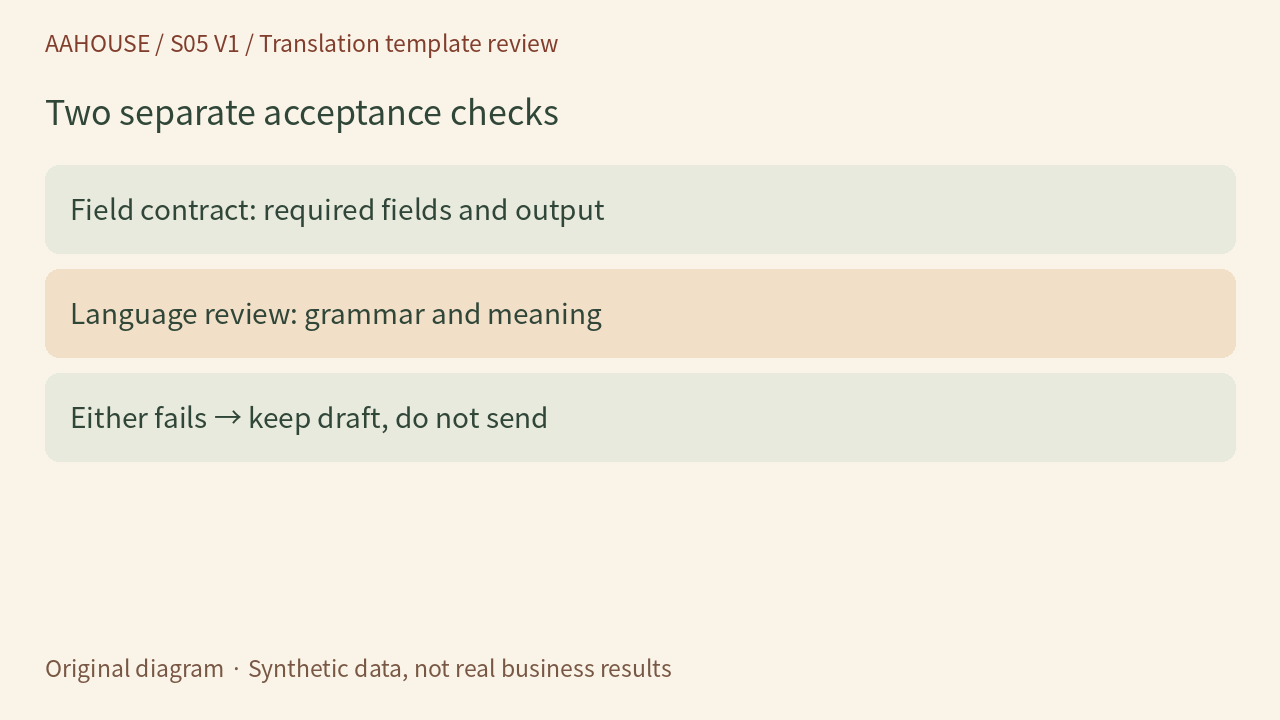
- Field contract: required fields and output
- Language review: grammar and meaning
- Either fails → keep draft, do not send
Original diagram · Synthetic data, not real business results