
Operations · Guide
Do not rename Speaker Zero as the manager
Separate anonymous speaker labels, employee identity and business commitments, retaining evidence for human verification.
Do not rename Speaker Zero as the manager
Original AAHouse explanatory video. AI-assisted conceptual visuals and neural narration; original music.
English transcript · Simplified Chinese Mandarin transcript · Taiwan Mandarin transcript · Macao Cantonese transcript
Do not rename Speaker Zero as the manager
In a fictional furniture-store transcript, Speaker Zero says, “I will check whether Friday delivery is possible.” The summary becomes “The manager promised Friday delivery.” Two unverified steps have slipped in: who spoke and whether the words made a commitment. This article is an editorial review sheet, not analysis of a real recording. Keep the anonymous speaker label until verified, and do not write that summary directly into the customer order.
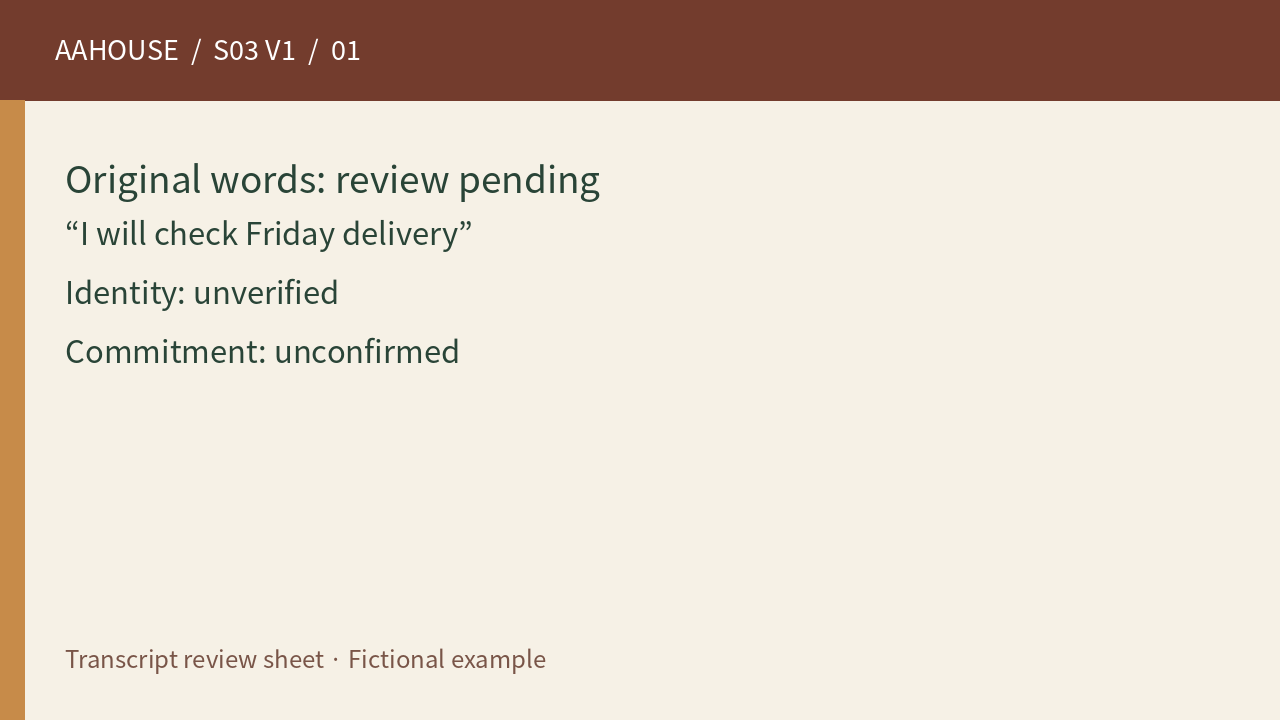
- “I will check Friday delivery”
- Identity: unverified
- Commitment: unconfirmed
Unchanged original source explanatory diagram.
Margin note one: a label groups speech
Amazon Transcribe diarization assigns distinct speaker labels to text and includes utterance timing.[1] The documentation’s spk_0 label is an output label, not an employee account. Our recommendation is to record voice grouping separately from verified identity. Do not assign a name merely from speaking order, seating, or a person being mentioned. A technical label should not silently become a business identity.
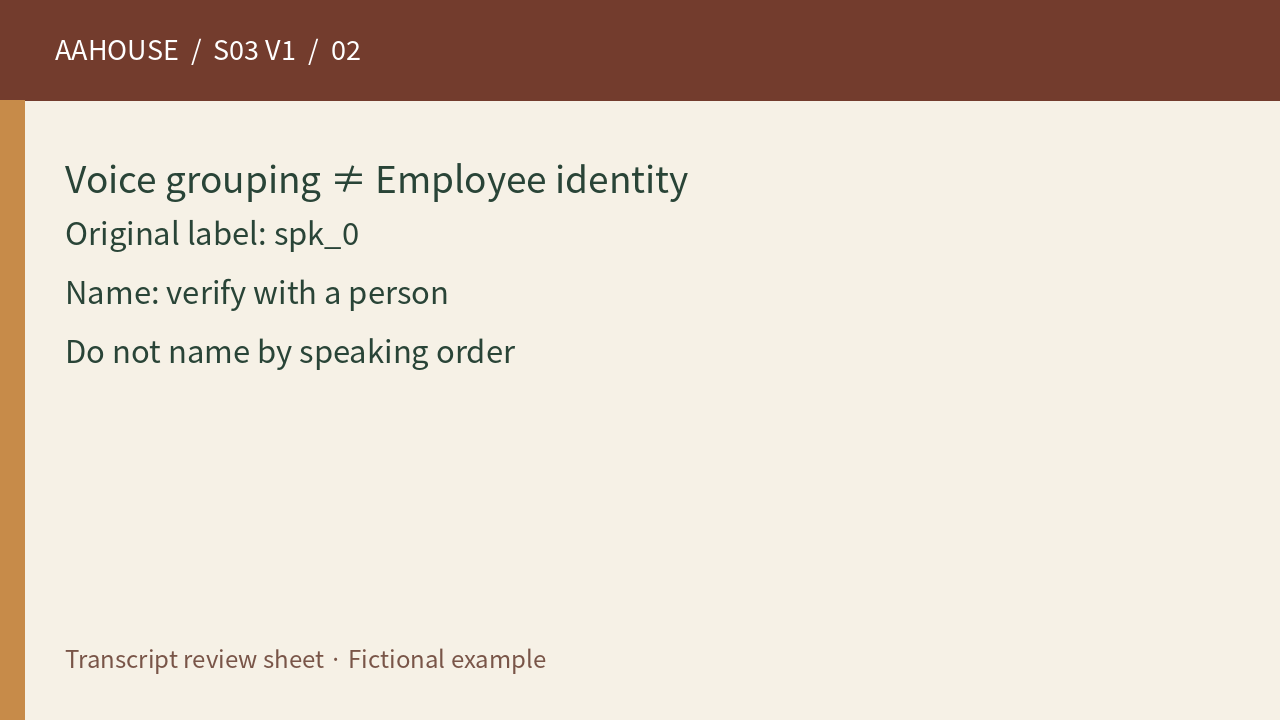
- Original label: spk_0
- Name: verify with a person
- Do not name by speaking order
Unchanged original source explanatory diagram.
Margin note two: words are not approval
AWS describes word-level timestamps and confidence scores in its transcription output.[2] These fields help locate material for review; they are not an approval record for a business commitment. Correctly transcribing “check” does not turn “check whether delivery is possible” into “delivery confirmed.” Our business-use analysis keeps the original words, interpretation, and confirmation status in separate fields rather than hiding all three inside a polished summary.
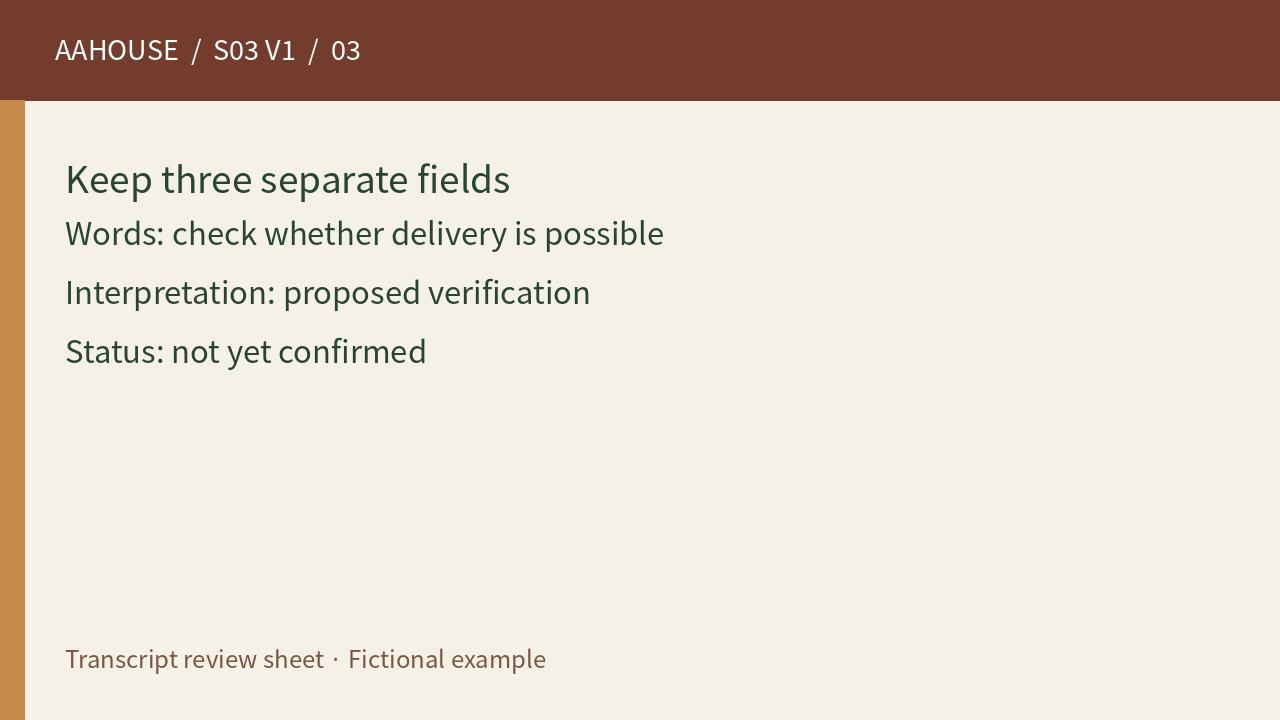
- Words: check whether delivery is possible
- Interpretation: proposed verification
- Status: not yet confirmed
Unchanged original source explanatory diagram.
Margin note three: keep a route back to audio
We recommend retaining a controlled recording reference, start and end times, original speaker label, human-verified name, and reviewer for important conclusions. Leave uncertain names blank and flag overlapping or unclear speech for review. Process material only within the recording and use permissions already obtained, with access and retention limits. Do not distribute an entire customer recording to unrelated groups simply to recruit more reviewers.
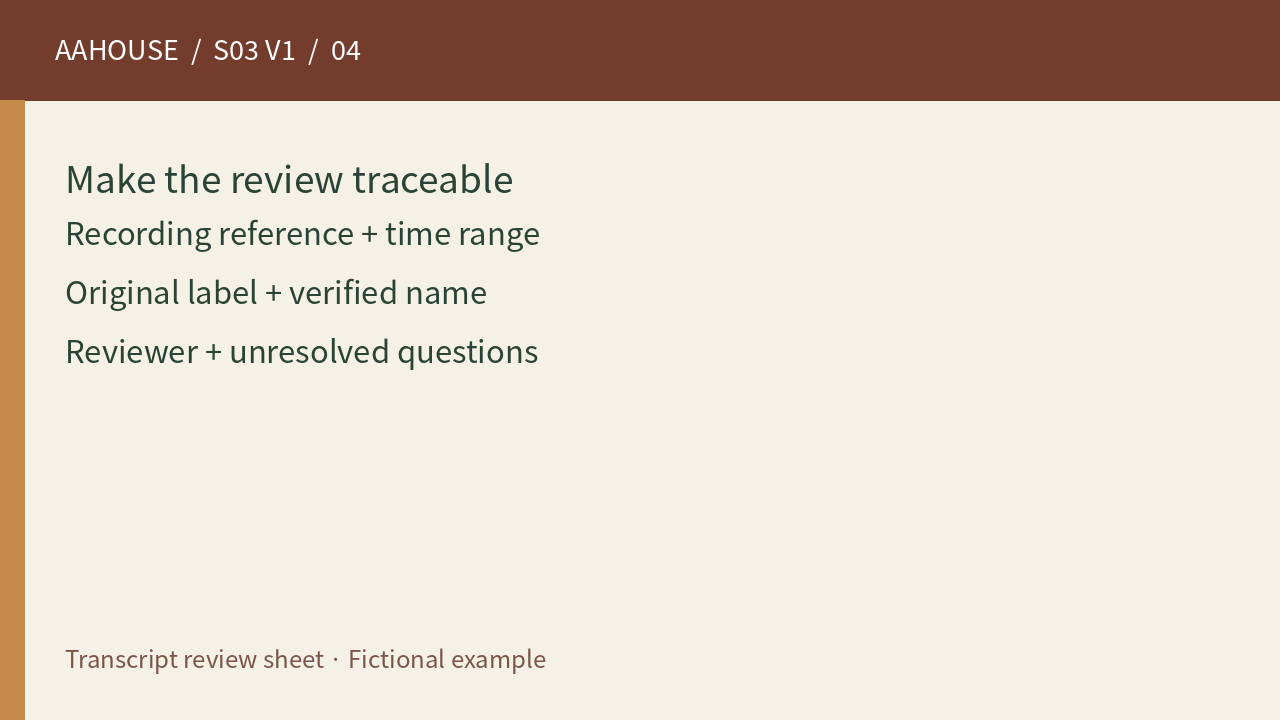
- Recording reference + time range
- Original label + verified name
- Reviewer + unresolved questions
Unchanged original source explanatory diagram.
Revision: keep uncertainty in the sentence
For the fictional shop, a safer revision says that an unidentified participant proposed checking whether Friday delivery was possible; the date still needs confirmation by the responsible person. A reviewer should revisit the relevant audio and ask participants when necessary. After verifying identity, separately check authority and the delivery conclusion. A corrected name also requires checking downstream tasks based on that attribution, not just editing one word in a transcript.
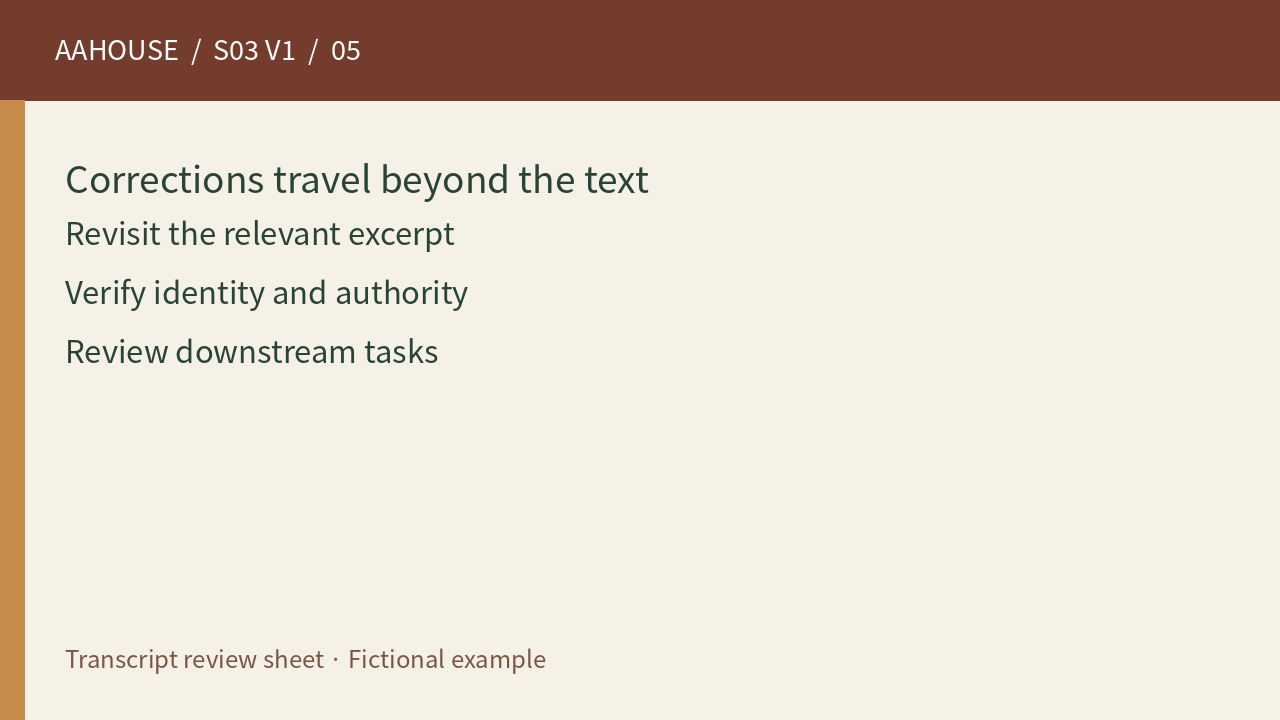
- Revisit the relevant excerpt
- Verify identity and authority
- Review downstream tasks
Unchanged original source explanatory diagram.
Handoff: three checks, not one score
Our proposed acceptance review separates wording, speaker attribution, and business meaning. Use authorized short excerpts to test negatives, conditions, interruptions, and uncertain identities; record corrections and unresolved items. No real-recording test was performed here. Before rollout, decide who can verify identity, who can approve a commitment, and how corrections reach downstream work. That makes automated summaries useful assistance rather than a way to assign responsibility by inference.
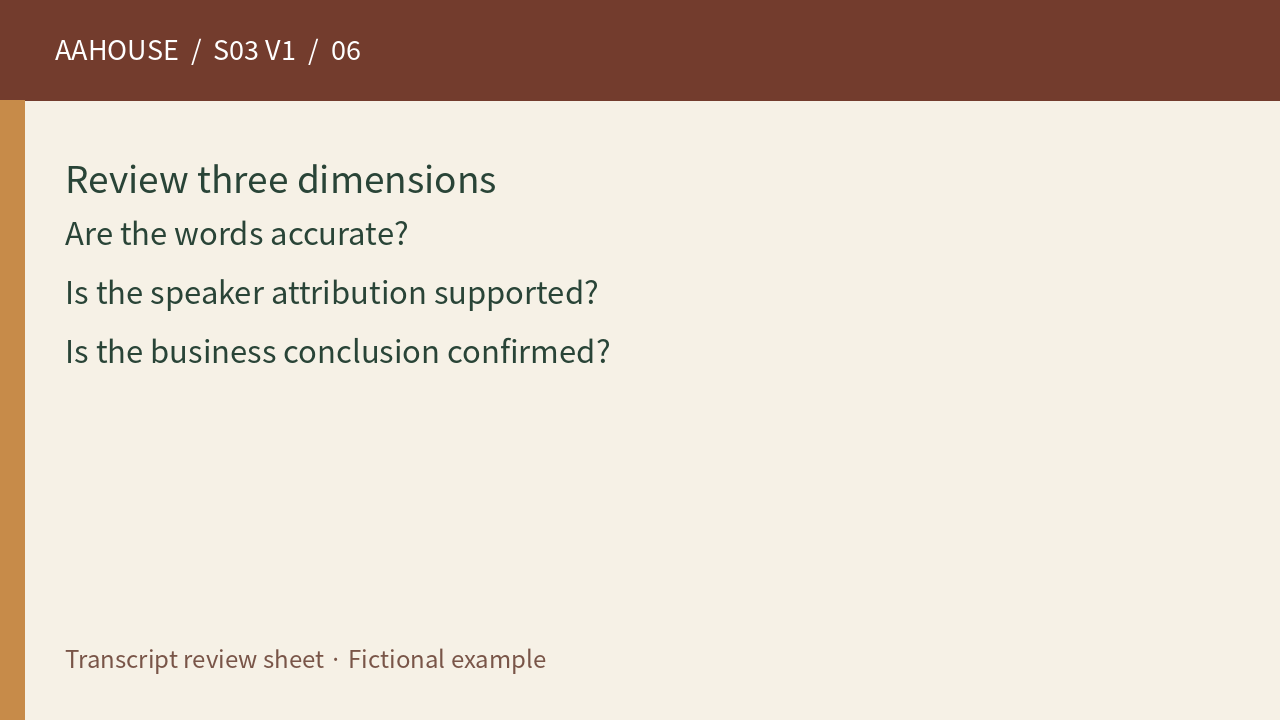
- Are the words accurate?
- Is the speaker attribution supported?
- Is the business conclusion confirmed?
Unchanged original source explanatory diagram.